
Archive | Make! RSS feed for this section

Make pizza night extra special | Make it!

5 May

My first day of outdoor Boot Camp yesterday morning and….PIZZA for DINNER! Sounds totally ridiculous, I know. But the best way to control what’s on your pizza is to make it yourself.

(SHHHH…don’t tell the kids…it’s also less expensive than ordering out!)

We’ve made our own crust in the past but opted for the next best thing last night — freshly made dough from our favorite local pizza shop. Truth be told, it’s much tastier than store bought dough…and cheaper. Most pizza shops only charge a dollar or so for a “dough ball”. We like our crust thin so 1 dough ball is plenty. Also, did you know the the “fresh” dough you buy in your local grocery store is often made, frozen & THEN put in the refrigerated section to thaw? Yuck!

Tips for handling dough

Make sure the dough is at room temp before you attempt to roll or toss it. Coat it with a little bit of flour or cornmeal (I like the crunch cornmeal adds after it’s baked) so it’s easy to form & doesn’t stick to your hands.

Patting it into a flat disk before rolling or tossing makes it easier to get an even shape. If tossing or stretching by hand (I prefer this method), use the tops of your hands/knuckles (vs. finger tips) and pull your hands outward, gently stretching the dough. This will help you avoid making any holes or tears.

Other tips

We loaded the pizza up with our favorite sauce and thinly sliced veggies (mushrooms, onions, red pepper & tomatoes). Tomatoes aren’t really tasty yet but Jess got 2 pints of cherry tomatoes on a crazy sale at the grocery store.  We roasted them in the oven before adding to them to the pizza (just toss a little bit of olive oil, salt & pepper with the tomatoes then spread them on a baking sheet & roast for about 15-20 minutes in a 400 degree oven). Roasting is a great trick for making tomatoes that aren’t in season super delicious.

Okay, consider the truth officially out. In high school (and summers in college), I worked at a pizza shop (affectionately knick named the “Pizza Shanty”) on Cape Cod, so I know a few secrets.

Cheese :: We generally use low fat cheese or regular cheese (just less of it). Jess recently bought some blocks of cheese that we’ve been shredding & slicing. It’s much more economical (thrifty!). I’ll admit, I’d gotten used to the convenience of buying shredded cheese but my parents always bought the blocks & shredded or sliced it. You could also buy local cheese at the farmer’s market or artisanal shop & make your pizza a little extra special! We like to use a variety of cheeses on our pizza. Last night: white cheddar & monterey jack.

Toppings :: Sauce & lightly cheese your dough then layer toppings, meat first, (if you’re just doing veggies, mushrooms count as “meat” so put those down first) then veggies. I like to put onions on last so they get a little caramelized. If you’re using fresh herbs layer them between toppings or sprinkle them on before adding any toppings so they don’t burn in the oven. Last step: sprinkle another light layer of cheese on top before tossing into the oven.

Cooking :: We had amazing pizza last summer that was cooked right on the grill. We don’t have a grill but we do have the next best thing…a pizza stone! It’s not just any pizza stone…please read on. We’ve had mixed results with pizza stones in the past. It’s one of those things that never seemed to work quite as promised and often ended up in the back of the cabinet & then for sale at our next yard sale. We’ve also tried cookie sheets, weird pizza pans with holes, etc. Our favorite tool by far is our Emile Henry Pizza Stone. It’s more versatile than your average pizza stone (it can be used on the grill & as a cook top for a variety of other items) and makes the crust super crispy. Preheating the oven is key! And whether you use a stone or cookie sheet, the trick is making sure you preheat it a bit before plopping the raw pizza dough on it. If you’re using a cookie sheet, brush it with a little oil before preheating. The oven temp should be about 425-450 degrees.

Cutting :: You don’t need any fancy cutting tools. A longer, sharp chef’s knife will do just fine. If you use a stone, you can cut the pizza right on it. If you use a cookie sheet, transfer pizza to a large wooden cutting board for easier cutting.

So…what are your favorite pizza toppings? Do you have any secret tips for making pizza at home?

Good things come to those who…share! | Thrifty trades

1 May

Remember that awesome partial roll of book binding leather I wrote about here that was taunting my making dreams?

Well, I need to be creative with how I use what I have left because I shared the good fortune (& the largest piece!) with my dad.  He’s a talented carpenter, wood turner & cabinet maker. “Projects” find their way into my dad’s garage, basement & workshop. Close friends of his have an antique business and they often drop off items that need to be fixed/restored. A recent addition, an adorable antique writing desk, needed a few small repairs and a new piece of desk blotter leather. As if it were meant to be, the largest piece of leather that I had nearly perfectly fit the designated spot.

You’d think I’d be a little sad, especially after coming across so many great scrap leather project ideas recently, but I love sharing a lucky find (thanks KH!) & I love trading. My dad’s friend is going to trade me something on my “thrift list” for the leather. Here are two things I have in mind.

I have fond memories of making brownies & cakes with my gran in these & have been on the hunt for a complete set for years // source //:

I’m always on the look out for more Cathrineholm pieces to add to our collection // source //:

What’s at the top of your thrift list?

Oh and stay tuned…I need to take stock of the remaining scraps and decide which projects I’m going to make from last week’s post.

Making Inspiration | Scrap Leather DIY

23 Apr

A (totally awesome) friend gave me a partial roll of thick leather when she was “cleaning house” in preparation for a move. It’s still nice & soft & it’s been sitting in the corner of our studio/office, for months, torturing me — visions of potential leather projects dancing in my head.

But what do I really know about working with leather? It’s a little intimidating but after sleuthing the interwebs it doesn’t seem so scary (yay!). Here’s what I came up with for potential projects. I’m most excited about the first three but they are all pretty amazing!

1. leather party decor (perfect everyday decor too!)

2. pretty little leather bow (oh the possibilities!)

3. more decor…leather bowl (for holding a head of garlic in the kitchen or top-of-dresser-items like jewelry & change?!)

4. another painted bracelet treat 
(perfect for adding interest to any everyday outfit!)

5. sweet leather flowers here & here (thanks fleurfatale & Martha!)

I don’t know about you…but I can’t wait to start making!

Recycle…Repurpose…Repeat | Yoga Mat Revival

19 Apr

Earth Day is this weekend so recycling, etc. has really been on my mind recently. And if you haven’t figured it out already, Jess & I are also thrifty/resourceful by nature.

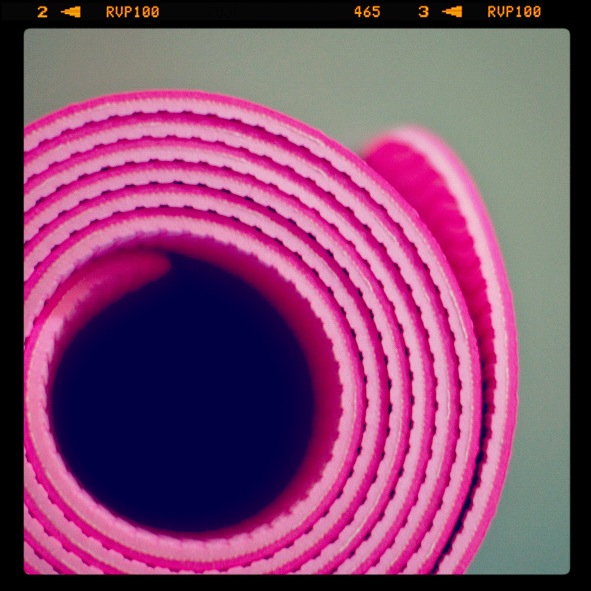
We got a new little rug for in front of the kitchen sink and I was sick of it slipping on the tile floor. I’ve bought non-slip-under-the-rug things from bargain stores but they don’t work that well so I’ve decided to stop wasting money on them — it all adds up! I’m too thrifty to invest in a more expensive option until we have our own house. I figured there had to be an alternative that would work well & possibly offer a little more cushion…then…bing! Idea! Light bulb above head & everything. I remembered seeing my old yoga mat tucked away in the corner of our closet when I was hunting for  my Spring/Summer clothes.

I laid the yoga mat out on the floor; measured a length & width about 1/4″-1/2″ smaller than the rug I wanted to put it under; marked it with a Sharpie marker & then cut it with sharp scissors. It’s been working perfectly & it adds a nice bit of cushion, too (which is great since we’re at the sink every night washing dishes…I can’t wait until we own a home…with a dishwasher!).

I put the remaining piece of yoga mat under a throw that’s on top of a trunk at the base of our bed (the dogs & cat like to use it as a step up to the bed & it’s an antique). It’s holding the throw in place nicely & we no longer have to forever fuss with it to keep it in check. Besides, now the boys have a little bit more of a cushion for jumping, too.

I’m not the only one who has thought of reusing/recycling/repurposing old yoga mats. I found this great link while setting out to write this post. So many awesome ideas!

My favorites are 2, 3, 5, 6, 8, 18, 26, 29, 31, 49.
#26 made me wonder if yoga mat would make a good baby changing mat? What about cutting a clean yoga mat down to a smaller size & tucking it your diaper bag? It’s so easy to wipe clean & would make changing away from home a little less stressful.

So…how do you plan to celebrate Earth Day? What things have you cleverly recycled or repurposed?

Decor DIY | The Easiest Roman Shades Ever!

15 Apr

I attempted to make roman shades from scratch once (key words = attempted, once). It was several years ago and I enlisted the help of my friend & fabric whisperer, Andrea. In the end the project FAILED (at no fault of Andrea’s), the mechanics were a total pain in the butt to figure out & I was left with a bag full of fabric, a ½ sewn, lined panel & roman shade guts (little plastic rings, dowels & several yards of nylon cord).

Recently, I found that bag while cleaning out my fabric stash and was reminded of how much I love the look of a roman shade. But they are $$$, hence the reason I wanted to make them in the first place.

Thanks to the interwebs, especially Pinterest, I found a much easier option. And…after finding the tutorial, I excitedly remembered:

  1. I had a few yards of fabric in a bright print leftover from wedding stuff (Jess wasn’t in love with it then for wedding crafts but was okay with it being in our office window)
  2. Our office/studio window had some icky mini blinds in it. They were left by the last tenant & we put up curtains over them & then quickly forgot about them. A note about this: I happen to know that our landlord didn’t supply the mini blinds so they were free game to use for this project. (Yay!)
So this project was essentially “free” to make. Well, truthfully, it was $5.49 because I had to buy fabric glue.

Supplies

Fabric (a mid-weight cotton worked for me but the other tutorials I’ve seen use burlap or heavier cotton canvas)

Mini blinds in a size to fit your window (use old ones & upcycle them or buy cheap ones at your nearest home supply store)

Fabric glue (I used “Liquid Stitch”)

Measuring tape

Heat N’ Bond iron-on hem tape

Fabric shears or super sharp scissors

Double sided craft tape

Iron

Optional supplies:
Pinking shears

Binder clips
Quilting ruler
Thread in a matching color (only if you plan to machine stitch your seams)
Hot glue gun (I didn’t use this but many of the tutorials did)

Instructions

I mostly used the instructions here  & referenced an older tutorial for steps I wasn’t sure about.

Here are a few notes/things I did differently:

:: Prepping the blinds: This was much easier than I thought. I can’t emphasize this next tip enough: BE CAREFUL NOT TO CUT THE LIFT CORD. You think it’s super obvious BUT it’s very easy to get into measuring & cutting & gluing & before you know it, you’re wondering why your scissors are having such a hard time cutting the fabric…& then you realize the lift cord was hiding under the fabric & you almost cut it & ruined the whole project. GAH! So….BE CAREFUL NOT TO CUT THE LIFT CORD.

:: Glue: I had all of the supplies required with the exception of the fabric glue. I bought it at a local sewing store & the brand I used was called “Liquid Stitch”. I used it to adhere the fabric to everything – the mini blind slats, the thicker mechanical bar at the top and the thick bottom slat. So far, it’s holding up just fine. I didn’t use hot glue at all.

:: Fabric: I used a medium weight cotton print. It’s the main reason I didn’t use hot glue – because I feel like it would be less forgiving than a heavy weight canvas or burlap & I didn’t want to see lumps & bumps on the finished shade.

:: Seams & “pattern”:

  • I left a 2.5” border around all of the edges.  Meaning, I measured & cut my piece of fabric 2.5″ bigger, on all sides, than what I wanted my finished shade to be. For the left and right sides, I folded the fabric in 2.5 ” & pressed it with an iron. I folded the flap of fabric under itself, sandwiched the Heat N’ Bond between the layers of fabric & pressed it, leaving me with a double thick seam that measured 1.25″. I did this to give a little more stability to the shade on the sides.
  • I left the top & bottom edges raw so I could play around/easily cut off any excess fabric
  • My pleats (where I glued the slats) are spaced 7.5” apart because that seemed to work the best with the length of my window
  • I used the recommended Heat N’ Bond (no sewing necessary!) for the hem but also used a sewing machine to reinforce the hem on each side to give it nice finished & clean look

:: Finishing:

  • I used binder clips (yes, your standard office supply binder clips) to temporarily hold the fabric in place as the glue was drying on the top mechanical bar & the thick bottom slat. This was a really helpful step.
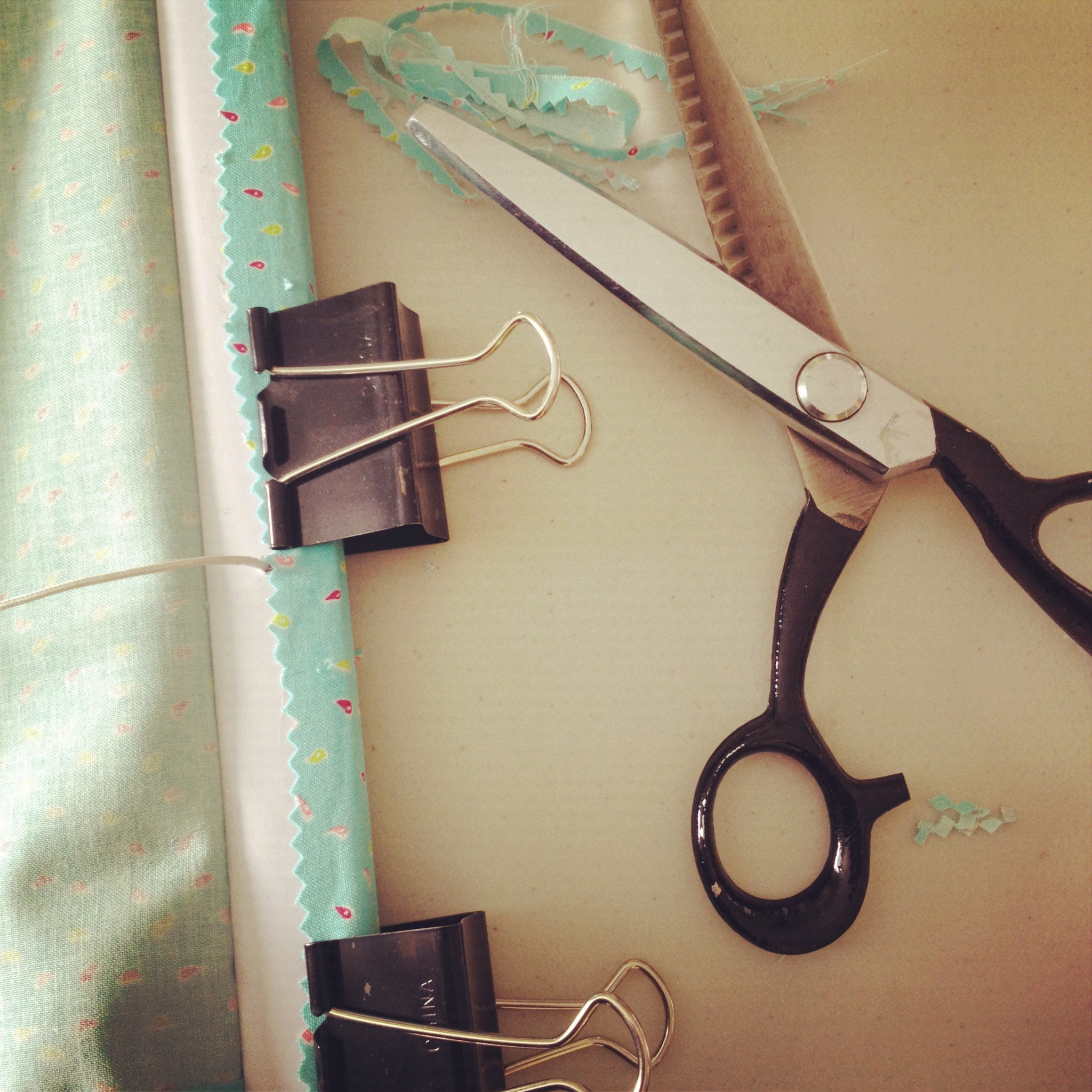
  • Once the glue on the top mechanical bar & bottom slat was dry, I used pinking shears to trim the excess fabric (to keep the raw edge of the fabric from fraying). As you are doing this, BE CAREFUL NOT TO CUT THE LIFT CORD!!!  I was extra careful not to cut or glue the lift cord in all of the earlier steps & then nearly cut one of them during this last finishing step. OMG! Crisis averted though…phew!
  • Once the finished shade was in place, I put a little piece of strong double-sided craft tape on both sliding pieces of the bracket that holds the top of the shade in place & pressed the top corners of the fabric down (as the instructions in the tutorials state, you have to keep the corners unglued in order to be able to install the shade).

And….voila!…a sexy looking roman shade for less!

So sexy in fact, we thought the trim & windowsill looked too drab after taking down the original curtains. So…I lightly sanded away any ickies, taped it off with painter’s tape & painted it a nice bright white. Even after painting, this project still took just 2 evenings to complete.

Have you ever had a project unknowingly turn into more projects? Let us know how things turned out.

Happy making!

Decor DIY | Frame it!

9 Apr

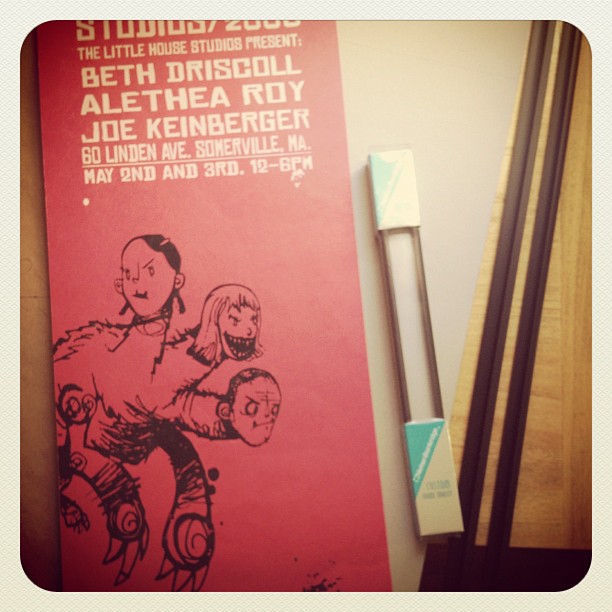
We have a small collection of screen printed posters created by local artist friends. They are unusual sizes & at first, the task of framing them seemed impossible or very expensive. While I’ve seen thrifty/creative ways to hang posters/prints like here & here, they don’t actually protect the art & we not only wanted to display them, but keep them protected, too.

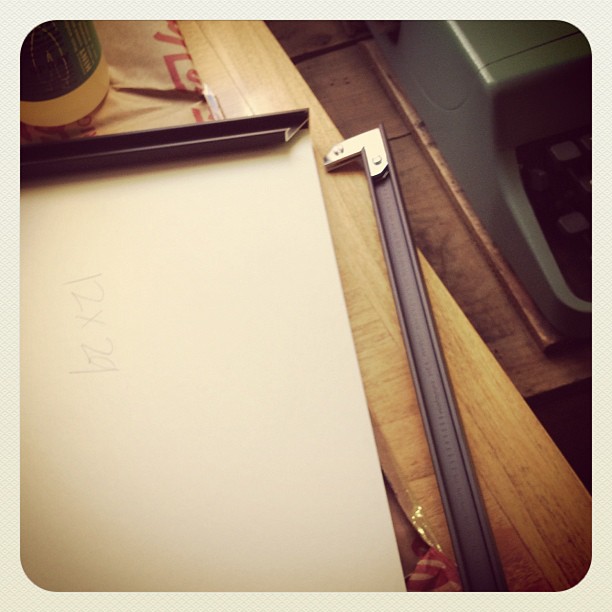
DIY framing kit to the rescue! We use the standard black metal ones for a cohesive look but they are available in a small variety of finishes.

Supplies

Artwork

Archival mat board cut to the size of your artwork (or chipboard, foam core, or even corrugated cardboard will do — but keep in mind if you use these, it won’t be archival)

Glass or plexiglass cut to the size of your artwork

Flat head screwdriver

2 framing kits (in the width & height of your artwork) such as these 

Instructions

The instructions are part of the framing kit packaging & they are very easy to follow. The whole kit takes about 10 minutes total to assemble (including the time it takes to clean the glass/dust off the plexi!). Easy peasy!

Tips…

Glass &  plexiglass: While you might think that plexiglass would be cheaper, it’s often not the case, so investigate before you buy. There are two hardware stores near me & one sells & cuts plexiglass and the other sells & cuts glass. Call your local hardware store to see if they custom cut glass/plexi before you stop in. Be careful while handling either material — the edges can be deceivingly sharp!

Savings:

  • I’ve found the same brand framing kits in craft stores that publish “40%-50% off one item” coupons weekly. This can be a great way to save even more $ with this project.
  • Keep an eye out for coupons at your local hardware store. I saved $3 on a piece of glass with a coupon from the back of our grocery shopping receipt (thanks to Jess!).

Cutting mat board:

  • Many art supply stores have a “cut your own” large format heavy duty cutter that that they’ll let you use for free (like the Utrecht in Cambridge, MA). Typically, you need to purchase your mat board/illustration board first & then ask to use it.
  • Many art supply stores will often cut mat board for a small fee per cut.
  • You can also cut your own at home if you have a long straight edge (I like cork-backed metal rulers because they provide a strong clean edge and don’t slip) and a utility knife – you don’t need to worry about what the edges look like because they’ll be hidden by the frame — so smooth cuts aren’t necessary to fuss over.

Happy framing!

Ingredient predicament | Hey, where’s the…?

7 Apr

We recently made these brownies to bring to a “Jaws” movie party. We topped them each with smattering of vanilla buttercream icing and a Swedish fish candy & affectionately named them “minnow brownies”. They were a hit. But I digress…

We always have baking essentials on hand (butter, eggs, flour, sugar, baking chocolate, etc.) so I don’t often think twice about ingredients until I pull down a baking book & start to gather them up by the armful. 

Here are two pantry substitutions (plus a bonus!) we used successfully in the above recipe.

  1. Unsweetened baker’s chocolate: We had 4 ounces and the recipe called for 6. For each ounce of baker’s chocolate, we substituted 3 TBS of unsweetened cocoa power & 1 TBS of oil. We used canola but any vegetable oil will do (except for olive oil!).
  2. Butter: We only had enough for the buttercream icing so in the brownie recipe, for the butter, we substituted 1 cup of shortening and 2 TBS of water for 1 cup of butter.

Another helpful substitution/DIY ingredient we’ve made in the past is buttermilk. Make your own buttermilk by adding 1 TBS of apple cider vinegar, white vinegar or lemon juice to 1 cup of milk. This can also be successfully done with soy milk as Jess did her Vegan Irish Soda Bread recipe last month. 

What’s your favorite baking or cooking ingredient substitution?

DIY Cheese | Homemade Ricotta

5 Apr


Recently, my friend, Emily, told me about Salvatore Bklyn. They make fresh artisanal ricotta cheese daily in Brooklyn, NY, using the finest whole milk sourced locally from upstate. After doing more research online, Kate & I fell in love with their story, product and website. Martha Stewart has proclaimed, “It’s my favorite ricotta in the whole world!”, and has featured them on her show. It made me want to attempt to try to make my own ricotta.

(Recipe courtesy of Betsy Devine Salvatore Bklyn)

Makes 4 cups

Ingredients

1 gallon whole milk (I used Shaw Farm milk from my hometown, Dracut, MA)
healthy pinch of salt
3/4 cup fresh lemon juice

Steps

1. Pour the milk into a large, nonreactive pot and season with salt (a healthy pinch). Cover the pot and place it over high heat. Heat the milk to 190 degrees (use a thermometer), stirring it every few minutes to keep it from scorching. Turn off the heat, remove from hot burner, and add the lemon juice. Stir slowly until you see curds beginning to form. (This should happen almost immediately; you’ve now created the curds and whey.) Let the pot sit undisturbed for 5 minutes.

2. Line a colander with cheesecloth and place it over another bowl (to catch the whey). Pour the curds and whey into the colander and let the curds strain for at least 1 hour, then discard the whey. Eat the cheese right away or transfer it to an airtight container and refrigerate until ready to use.

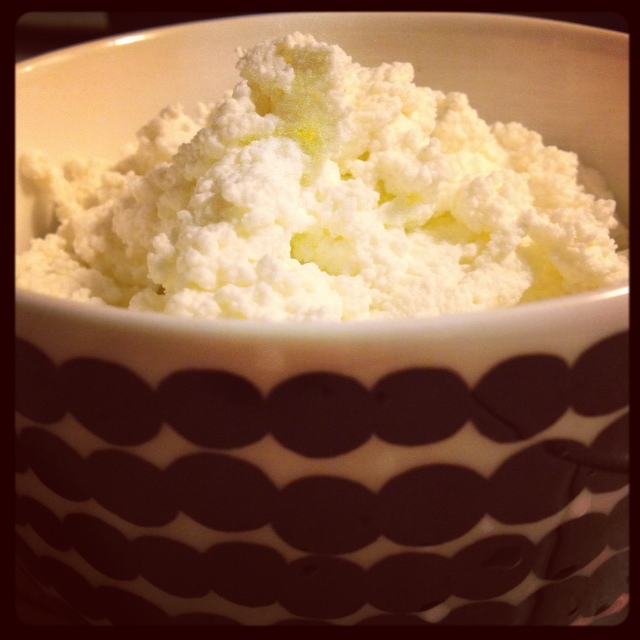
The results were amazing. This ricotta is delicate and fluffy, best eaten with a pinch of salt and fresh cracked pepper. yum.

Meals featuring this amazing ricotta:  

#1: Toasted baguette slathered with roasted garlic topped with oven roasted cherry tomatoes and a heaping of ricotta.
Sprinkle sea salt and cracked black pepper and add a drizzle of your favorite extra virgin olive oil. Tasty with a simple side salad of mixed greens dressed in olive oil and champagne vinegar.

#2: Toasted baguette rubbed with a fresh garlic clove and topped with 2 tsp of pasta sauce, ricotta and a sprinkle of sea salt, pepper & oregano. Drizzle with olive oil.

#3: Egg white omelette with ricotta, sea salt and cracked pepper. (Courtesy of our friend, Cobi!)

Weekend Project | Sewing Table Redux

2 Apr

I’ve been reorganizing our shared office/studio for the past few months. Things are coming along — we installed a pegboard using this post and hung a wall o’ artwork — but my new-to-me (salvaged from behind our building!) sewing table still needed a makeover…big time.

I had an amazing piece of fabric (designed by the author of one of my favorite blogs) I’d stashed away just waiting for the PERFECT project. Yay!

 Lowly old table + cute fabric + vinyl + a little elbow grease + a couple of hours = Awesome sewing table!

Supplies

Table that needs a makeover

Sharp scissors and/or sewing shears

Double-sided tape

Fabric in a fun print (You’ll need enough fabric so that it will lay flat on your table & fall over the edge a few inches — I left ~ 4 inches on each side)

Clear vinyl (Same size as the fabric, see above note —  available at any sewing/fabric store – the stuff I used was fairly heavy weight)

Drop cloth or old flat sheet

Heavy duty staple gun & staples

Lint roller 

Steps

1. Prep: Make sure your table is nice & clean – the underside too (you’ll be all up under there!). Iron your fabric. If your vinyl has any creases or wrinkles in it, now would be a good time to lay it out on a clean flat surface in a warm room.

2. Drape: Drape the fabric (right side up) over the tabletop allowing it to hang over the edges.

3. Trim: Using sharp scissors or sewing shears, trim the edges of the fabric so that only about 3-4 inches hang over the edge.

4. Anchor: Cut a piece of double-sided tape & peel the paper off one side. Lift a section of fabric & stick the piece of double-sided tape to the edge of the table. Remove the other piece of paper & press the fabric down, holding it for a few seconds to make sure it sticks. The goal here is simply to keep the fabric temporarily positioned in order for you to turn the table onto the floor.  You can skip this step if you’re not worried about the print/pattern lining up on the finished piece. 

5. Flip: Lay your drop cloth/sheet down on the floor & flip the table, top side down, on the cloth. Do this carefully so your fabric doesn’t come un-taped or shift as you flip.

6. Staple: Starting with one of the longer edges of the table (about an inch from the corner), gently but firmly pull the fabric over the edge of the table & staple it down with the staple gun about 1-1.5 inches from the table edge. You want to pull the fabric tight but not too tight or you’ll distort the print. Continue stapling along the edge, stopping about an inch before the corner. Repeat this step for the opposite edge & then the 2 other sides.

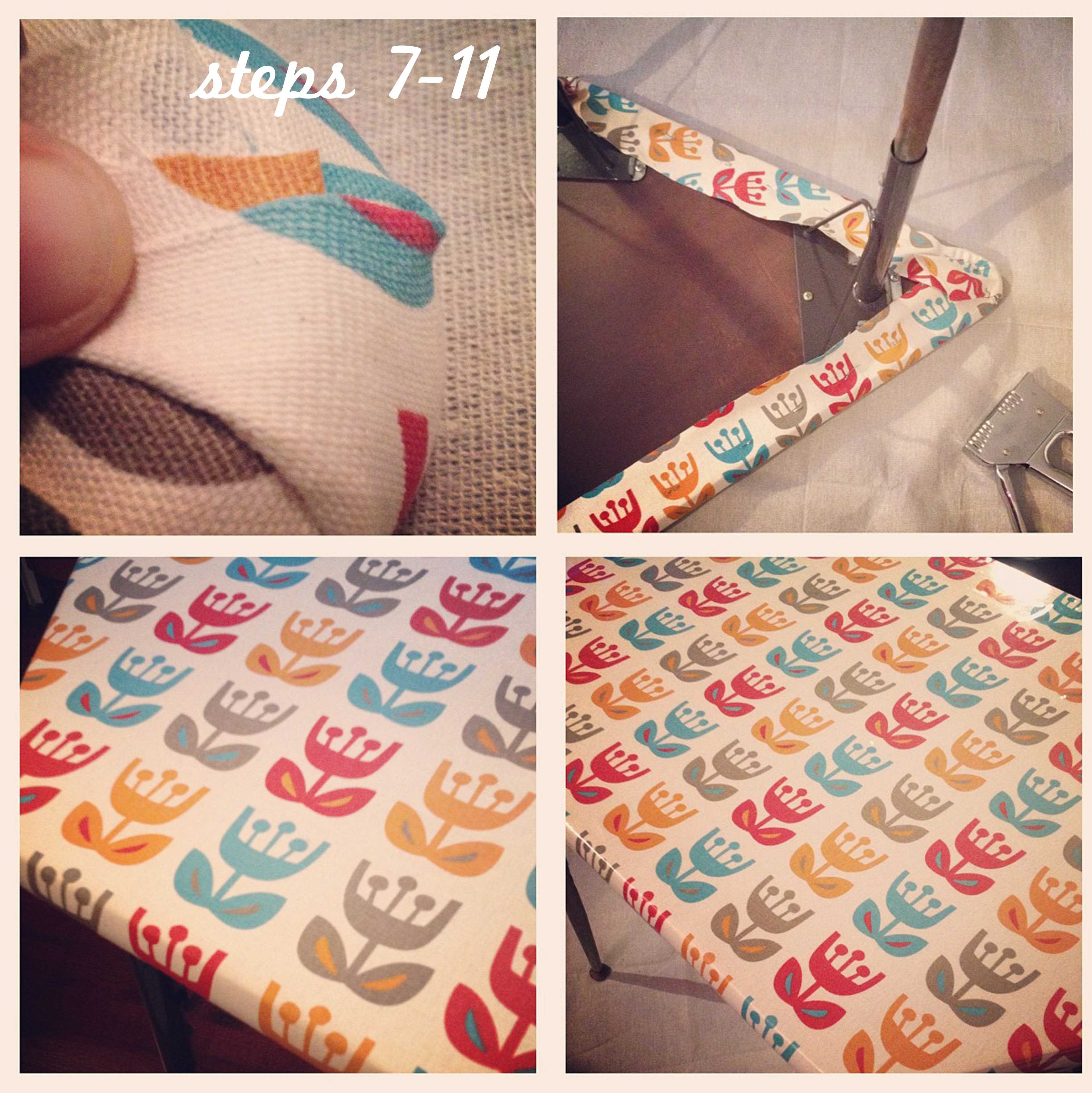
7. Corner up: Pull the fabric up at a 90 degree angle and pull firmly inward. 

If the corner is rounded (like mine), it will naturally make a little pleat of sorts when you pull up & in, it’s okay, just roll with it but feel free to adjust how it looks before you staple it down. Staple it a few times to anchor it securely to the table.

If your corner is sharp, pull one edge in towards the center of the table & staple it down. Tuck & fold the fabric however you need to get a nice crisp corner before stapling the heck out of it.

8. Trim: Using your fabric shears/scissors, trim the edge of the fabric to even it out a bit & get rid of any floppy edges. I started using a straight edge & rotary cutter on one side & soon realized it was silly so I eyeballed the rest. It will be hidden, after all!

9. Flip: Turn your table right side up & use a lint roller to catch any stray fabric bits or dust (or pet hair) from the fabric. It will drive you nuts if you accidently trap a hair or thread forever in the next step!

10. Repeat steps 2-8 using the vinyl. You can be a little firmer with the vinyl because you want to pull it taut. Especially in step 7 – you’ll want to pull a little tighter on the vinyl so it stretches nicely over the corners.

11. Turn the table right side up & admire your work!

Maker’s notes:  
I was oh-so-excited to get this project started, I forgot to take a “before” picture! Oops! 
I ran out of the right staples as I was about 3/4 of the way into the project so I finished it with staples that weren’t quite meant for the job (they had little arcs at the top for fastening cords to a surface). I smashed the extra metal flat with a hammer. I’d recommend running to your nearest home store for a refill instead of making due as I did.

Weekday Breakfast Treat | Almond Butter Delight

28 Mar

A couple of years ago I was fortunate enough to spend a few days at Canyon Ranch on a work trip to Arizona.

The food was delicious and healthy. It was refreshing not to have to worry about scavenging protein for breakfast or deconstructing pre-made hotel sandwiches to create a healthier lunch option.

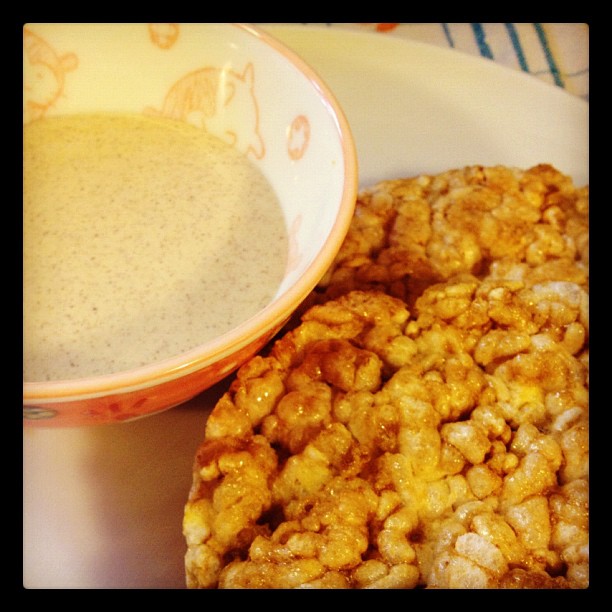
This recipe was one of my favorite things from the breakfast spread at Canyon Ranch. I like to put it on thin wheat crackers (like Ak Mak or Wasa Thin & Crispy Flatbread). Jess prefers to spread it on caramel rice cakes. It would also be yummy as a dip for fresh fruit.

My favorite thing about it (aside from it’s deliciousness) is that it’s really easy to whip up a batch for the week.

(Recipe from Canyon Ranch)

Makes 10 (2-TBS) servings

Ingredients

1 cup nonfat ricotta cheese 

2 tsp vanilla extract

½ tsp ground cinnamon

1 ½ TBS honey

¼ cup almond butter (without added salt)

Steps

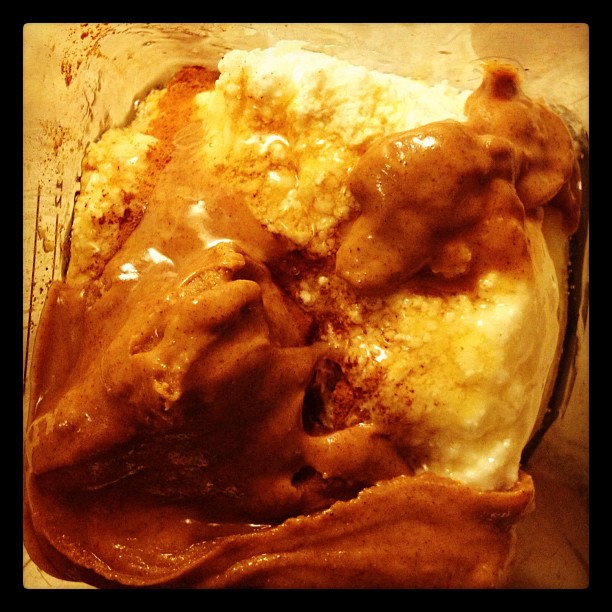
1. Combine all ingredients in a blender container & puree until smooth. (It might seem a little loose but it will firm up a bit after it’s been chilled in the refrigerator for a few hours.)

2. Chill in the refrigerator until ready to use. Enjoy within one week.

Nutritional info: 65 calories, 4 grams fat, 5 grams protein, 5 grams carbohydrate, 2 milligrams cholesterol, 12 milligrams sodium, trace fiber 

 Notes: I buy the highest quality ricotta that I can find & swear it makes all of the difference in this recipe. My favorite is Calabro Fat Free Ricotta. It’s so good I eat it straight out of the container sprinkled with a little bit of salt & pepper. YUM!

 Tip for accurately measuring honey in recipes: Spray the measuring cup or measuring spoon with a little bit of non-stick cooking spray before measuring the honey. The honey will easily slide into the recipe – no sticky messes or sad dollops left behind on the measuring implement.