Archive by Author

Recycle…Repurpose…Repeat | Yoga Mat Revival

19 Apr

Earth Day is this weekend so recycling, etc. has really been on my mind recently. And if you haven’t figured it out already, Jess & I are also thrifty/resourceful by nature.

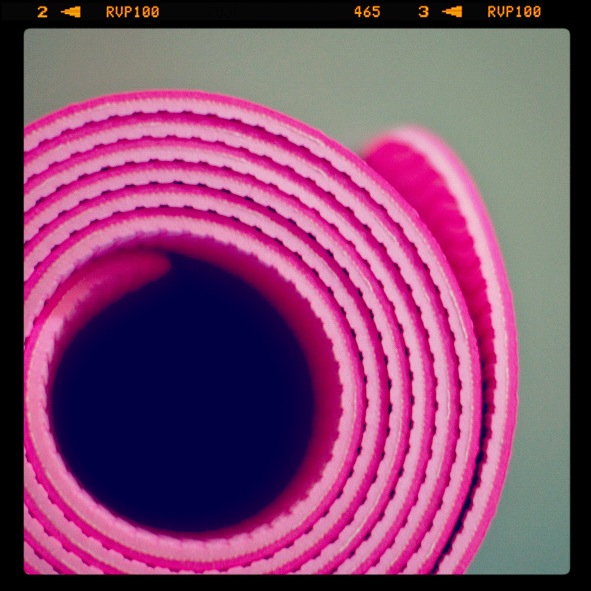
We got a new little rug for in front of the kitchen sink and I was sick of it slipping on the tile floor. I’ve bought non-slip-under-the-rug things from bargain stores but they don’t work that well so I’ve decided to stop wasting money on them — it all adds up! I’m too thrifty to invest in a more expensive option until we have our own house. I figured there had to be an alternative that would work well & possibly offer a little more cushion…then…bing! Idea! Light bulb above head & everything. I remembered seeing my old yoga mat tucked away in the corner of our closet when I was hunting for  my Spring/Summer clothes.

I laid the yoga mat out on the floor; measured a length & width about 1/4″-1/2″ smaller than the rug I wanted to put it under; marked it with a Sharpie marker & then cut it with sharp scissors. It’s been working perfectly & it adds a nice bit of cushion, too (which is great since we’re at the sink every night washing dishes…I can’t wait until we own a home…with a dishwasher!).

I put the remaining piece of yoga mat under a throw that’s on top of a trunk at the base of our bed (the dogs & cat like to use it as a step up to the bed & it’s an antique). It’s holding the throw in place nicely & we no longer have to forever fuss with it to keep it in check. Besides, now the boys have a little bit more of a cushion for jumping, too.

I’m not the only one who has thought of reusing/recycling/repurposing old yoga mats. I found this great link while setting out to write this post. So many awesome ideas!

My favorites are 2, 3, 5, 6, 8, 18, 26, 29, 31, 49.
#26 made me wonder if yoga mat would make a good baby changing mat? What about cutting a clean yoga mat down to a smaller size & tucking it your diaper bag? It’s so easy to wipe clean & would make changing away from home a little less stressful.

So…how do you plan to celebrate Earth Day? What things have you cleverly recycled or repurposed?

Decor DIY | The Easiest Roman Shades Ever!

15 Apr

I attempted to make roman shades from scratch once (key words = attempted, once). It was several years ago and I enlisted the help of my friend & fabric whisperer, Andrea. In the end the project FAILED (at no fault of Andrea’s), the mechanics were a total pain in the butt to figure out & I was left with a bag full of fabric, a ½ sewn, lined panel & roman shade guts (little plastic rings, dowels & several yards of nylon cord).

Recently, I found that bag while cleaning out my fabric stash and was reminded of how much I love the look of a roman shade. But they are $$$, hence the reason I wanted to make them in the first place.

Thanks to the interwebs, especially Pinterest, I found a much easier option. And…after finding the tutorial, I excitedly remembered:

  1. I had a few yards of fabric in a bright print leftover from wedding stuff (Jess wasn’t in love with it then for wedding crafts but was okay with it being in our office window)
  2. Our office/studio window had some icky mini blinds in it. They were left by the last tenant & we put up curtains over them & then quickly forgot about them. A note about this: I happen to know that our landlord didn’t supply the mini blinds so they were free game to use for this project. (Yay!)
So this project was essentially “free” to make. Well, truthfully, it was $5.49 because I had to buy fabric glue.

Supplies

Fabric (a mid-weight cotton worked for me but the other tutorials I’ve seen use burlap or heavier cotton canvas)

Mini blinds in a size to fit your window (use old ones & upcycle them or buy cheap ones at your nearest home supply store)

Fabric glue (I used “Liquid Stitch”)

Measuring tape

Heat N’ Bond iron-on hem tape

Fabric shears or super sharp scissors

Double sided craft tape

Iron

Optional supplies:
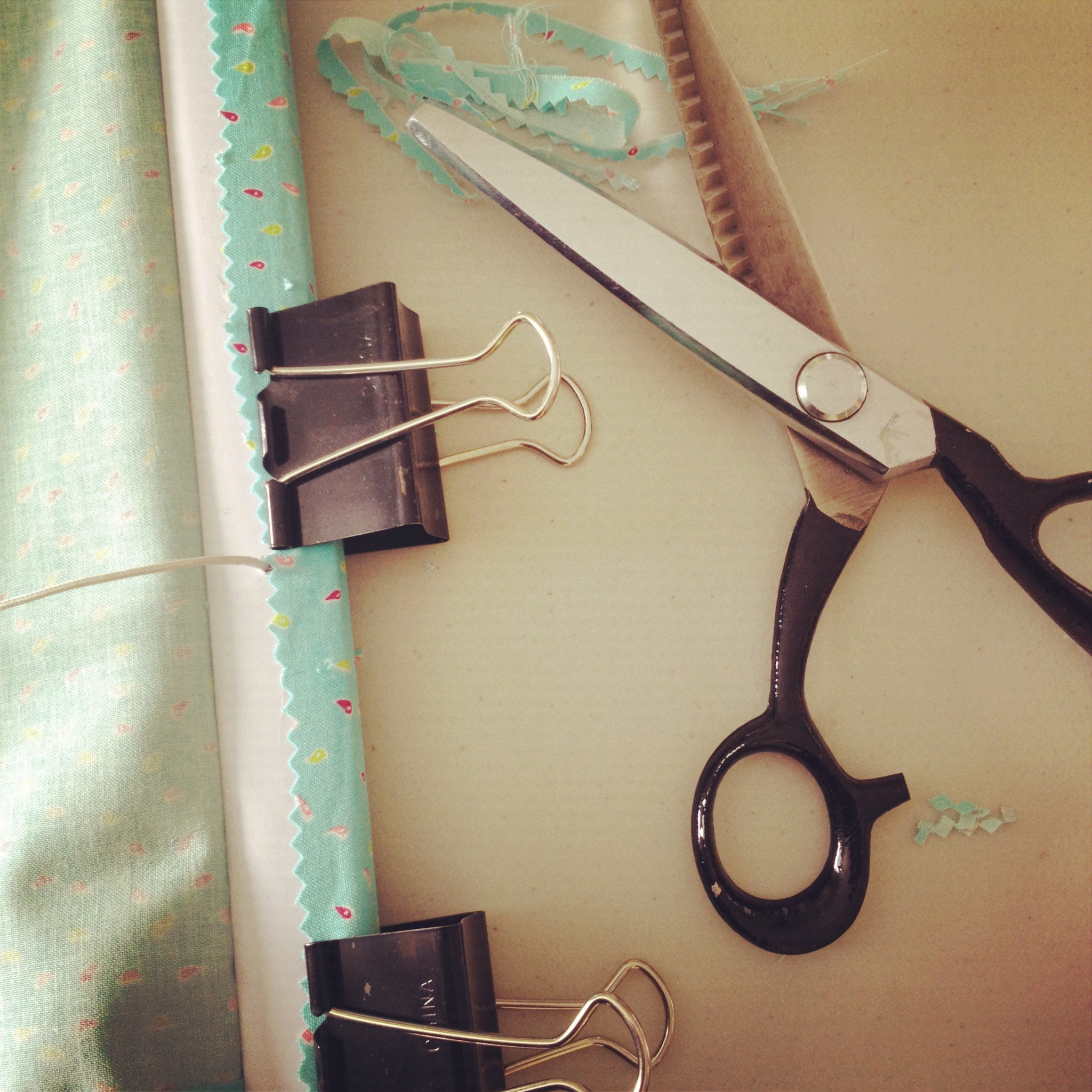
Pinking shears

Binder clips
Quilting ruler
Thread in a matching color (only if you plan to machine stitch your seams)
Hot glue gun (I didn’t use this but many of the tutorials did)

Instructions

I mostly used the instructions here  & referenced an older tutorial for steps I wasn’t sure about.

Here are a few notes/things I did differently:

:: Prepping the blinds: This was much easier than I thought. I can’t emphasize this next tip enough: BE CAREFUL NOT TO CUT THE LIFT CORD. You think it’s super obvious BUT it’s very easy to get into measuring & cutting & gluing & before you know it, you’re wondering why your scissors are having such a hard time cutting the fabric…& then you realize the lift cord was hiding under the fabric & you almost cut it & ruined the whole project. GAH! So….BE CAREFUL NOT TO CUT THE LIFT CORD.

:: Glue: I had all of the supplies required with the exception of the fabric glue. I bought it at a local sewing store & the brand I used was called “Liquid Stitch”. I used it to adhere the fabric to everything – the mini blind slats, the thicker mechanical bar at the top and the thick bottom slat. So far, it’s holding up just fine. I didn’t use hot glue at all.

:: Fabric: I used a medium weight cotton print. It’s the main reason I didn’t use hot glue – because I feel like it would be less forgiving than a heavy weight canvas or burlap & I didn’t want to see lumps & bumps on the finished shade.

:: Seams & “pattern”:

  • I left a 2.5” border around all of the edges.  Meaning, I measured & cut my piece of fabric 2.5″ bigger, on all sides, than what I wanted my finished shade to be. For the left and right sides, I folded the fabric in 2.5 ” & pressed it with an iron. I folded the flap of fabric under itself, sandwiched the Heat N’ Bond between the layers of fabric & pressed it, leaving me with a double thick seam that measured 1.25″. I did this to give a little more stability to the shade on the sides.
  • I left the top & bottom edges raw so I could play around/easily cut off any excess fabric
  • My pleats (where I glued the slats) are spaced 7.5” apart because that seemed to work the best with the length of my window
  • I used the recommended Heat N’ Bond (no sewing necessary!) for the hem but also used a sewing machine to reinforce the hem on each side to give it nice finished & clean look

:: Finishing:

  • I used binder clips (yes, your standard office supply binder clips) to temporarily hold the fabric in place as the glue was drying on the top mechanical bar & the thick bottom slat. This was a really helpful step.
  • Once the glue on the top mechanical bar & bottom slat was dry, I used pinking shears to trim the excess fabric (to keep the raw edge of the fabric from fraying). As you are doing this, BE CAREFUL NOT TO CUT THE LIFT CORD!!!  I was extra careful not to cut or glue the lift cord in all of the earlier steps & then nearly cut one of them during this last finishing step. OMG! Crisis averted though…phew!
  • Once the finished shade was in place, I put a little piece of strong double-sided craft tape on both sliding pieces of the bracket that holds the top of the shade in place & pressed the top corners of the fabric down (as the instructions in the tutorials state, you have to keep the corners unglued in order to be able to install the shade).

And….voila!…a sexy looking roman shade for less!

So sexy in fact, we thought the trim & windowsill looked too drab after taking down the original curtains. So…I lightly sanded away any ickies, taped it off with painter’s tape & painted it a nice bright white. Even after painting, this project still took just 2 evenings to complete.

Have you ever had a project unknowingly turn into more projects? Let us know how things turned out.

Happy making!

Decor DIY | Frame it!

9 Apr

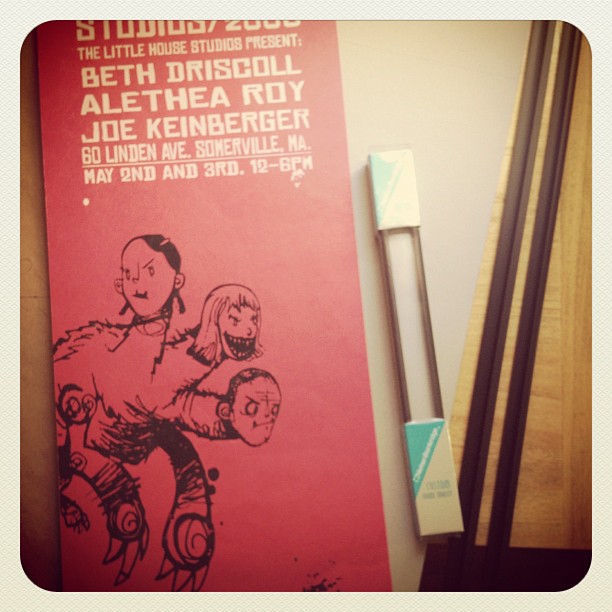
We have a small collection of screen printed posters created by local artist friends. They are unusual sizes & at first, the task of framing them seemed impossible or very expensive. While I’ve seen thrifty/creative ways to hang posters/prints like here & here, they don’t actually protect the art & we not only wanted to display them, but keep them protected, too.

DIY framing kit to the rescue! We use the standard black metal ones for a cohesive look but they are available in a small variety of finishes.

Supplies

Artwork

Archival mat board cut to the size of your artwork (or chipboard, foam core, or even corrugated cardboard will do — but keep in mind if you use these, it won’t be archival)

Glass or plexiglass cut to the size of your artwork

Flat head screwdriver

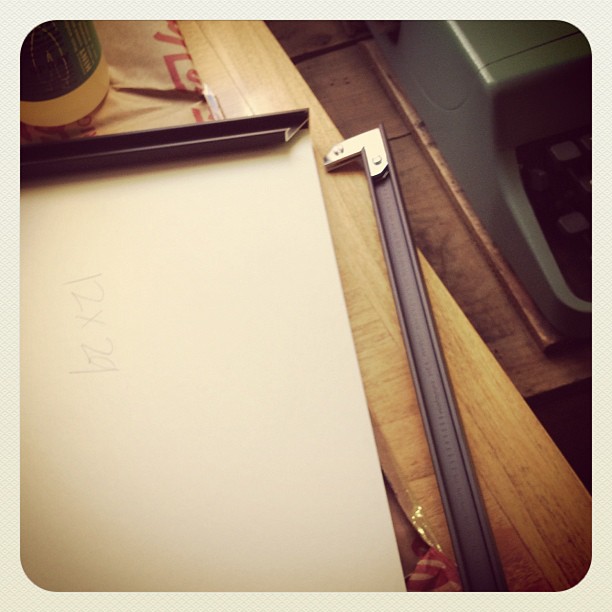
2 framing kits (in the width & height of your artwork) such as these 

Instructions

The instructions are part of the framing kit packaging & they are very easy to follow. The whole kit takes about 10 minutes total to assemble (including the time it takes to clean the glass/dust off the plexi!). Easy peasy!

Tips…

Glass &  plexiglass: While you might think that plexiglass would be cheaper, it’s often not the case, so investigate before you buy. There are two hardware stores near me & one sells & cuts plexiglass and the other sells & cuts glass. Call your local hardware store to see if they custom cut glass/plexi before you stop in. Be careful while handling either material — the edges can be deceivingly sharp!

Savings:

  • I’ve found the same brand framing kits in craft stores that publish “40%-50% off one item” coupons weekly. This can be a great way to save even more $ with this project.
  • Keep an eye out for coupons at your local hardware store. I saved $3 on a piece of glass with a coupon from the back of our grocery shopping receipt (thanks to Jess!).

Cutting mat board:

  • Many art supply stores have a “cut your own” large format heavy duty cutter that that they’ll let you use for free (like the Utrecht in Cambridge, MA). Typically, you need to purchase your mat board/illustration board first & then ask to use it.
  • Many art supply stores will often cut mat board for a small fee per cut.
  • You can also cut your own at home if you have a long straight edge (I like cork-backed metal rulers because they provide a strong clean edge and don’t slip) and a utility knife – you don’t need to worry about what the edges look like because they’ll be hidden by the frame — so smooth cuts aren’t necessary to fuss over.

Happy framing!

Ingredient predicament | Hey, where’s the…?

7 Apr

We recently made these brownies to bring to a “Jaws” movie party. We topped them each with smattering of vanilla buttercream icing and a Swedish fish candy & affectionately named them “minnow brownies”. They were a hit. But I digress…

We always have baking essentials on hand (butter, eggs, flour, sugar, baking chocolate, etc.) so I don’t often think twice about ingredients until I pull down a baking book & start to gather them up by the armful. 

Here are two pantry substitutions (plus a bonus!) we used successfully in the above recipe.

  1. Unsweetened baker’s chocolate: We had 4 ounces and the recipe called for 6. For each ounce of baker’s chocolate, we substituted 3 TBS of unsweetened cocoa power & 1 TBS of oil. We used canola but any vegetable oil will do (except for olive oil!).
  2. Butter: We only had enough for the buttercream icing so in the brownie recipe, for the butter, we substituted 1 cup of shortening and 2 TBS of water for 1 cup of butter.

Another helpful substitution/DIY ingredient we’ve made in the past is buttermilk. Make your own buttermilk by adding 1 TBS of apple cider vinegar, white vinegar or lemon juice to 1 cup of milk. This can also be successfully done with soy milk as Jess did her Vegan Irish Soda Bread recipe last month. 

What’s your favorite baking or cooking ingredient substitution?

Weekend Project | Sewing Table Redux

2 Apr

I’ve been reorganizing our shared office/studio for the past few months. Things are coming along — we installed a pegboard using this post and hung a wall o’ artwork — but my new-to-me (salvaged from behind our building!) sewing table still needed a makeover…big time.

I had an amazing piece of fabric (designed by the author of one of my favorite blogs) I’d stashed away just waiting for the PERFECT project. Yay!

 Lowly old table + cute fabric + vinyl + a little elbow grease + a couple of hours = Awesome sewing table!

Supplies

Table that needs a makeover

Sharp scissors and/or sewing shears

Double-sided tape

Fabric in a fun print (You’ll need enough fabric so that it will lay flat on your table & fall over the edge a few inches — I left ~ 4 inches on each side)

Clear vinyl (Same size as the fabric, see above note —  available at any sewing/fabric store – the stuff I used was fairly heavy weight)

Drop cloth or old flat sheet

Heavy duty staple gun & staples

Lint roller 

Steps

1. Prep: Make sure your table is nice & clean – the underside too (you’ll be all up under there!). Iron your fabric. If your vinyl has any creases or wrinkles in it, now would be a good time to lay it out on a clean flat surface in a warm room.

2. Drape: Drape the fabric (right side up) over the tabletop allowing it to hang over the edges.

3. Trim: Using sharp scissors or sewing shears, trim the edges of the fabric so that only about 3-4 inches hang over the edge.

4. Anchor: Cut a piece of double-sided tape & peel the paper off one side. Lift a section of fabric & stick the piece of double-sided tape to the edge of the table. Remove the other piece of paper & press the fabric down, holding it for a few seconds to make sure it sticks. The goal here is simply to keep the fabric temporarily positioned in order for you to turn the table onto the floor.  You can skip this step if you’re not worried about the print/pattern lining up on the finished piece. 

5. Flip: Lay your drop cloth/sheet down on the floor & flip the table, top side down, on the cloth. Do this carefully so your fabric doesn’t come un-taped or shift as you flip.

6. Staple: Starting with one of the longer edges of the table (about an inch from the corner), gently but firmly pull the fabric over the edge of the table & staple it down with the staple gun about 1-1.5 inches from the table edge. You want to pull the fabric tight but not too tight or you’ll distort the print. Continue stapling along the edge, stopping about an inch before the corner. Repeat this step for the opposite edge & then the 2 other sides.

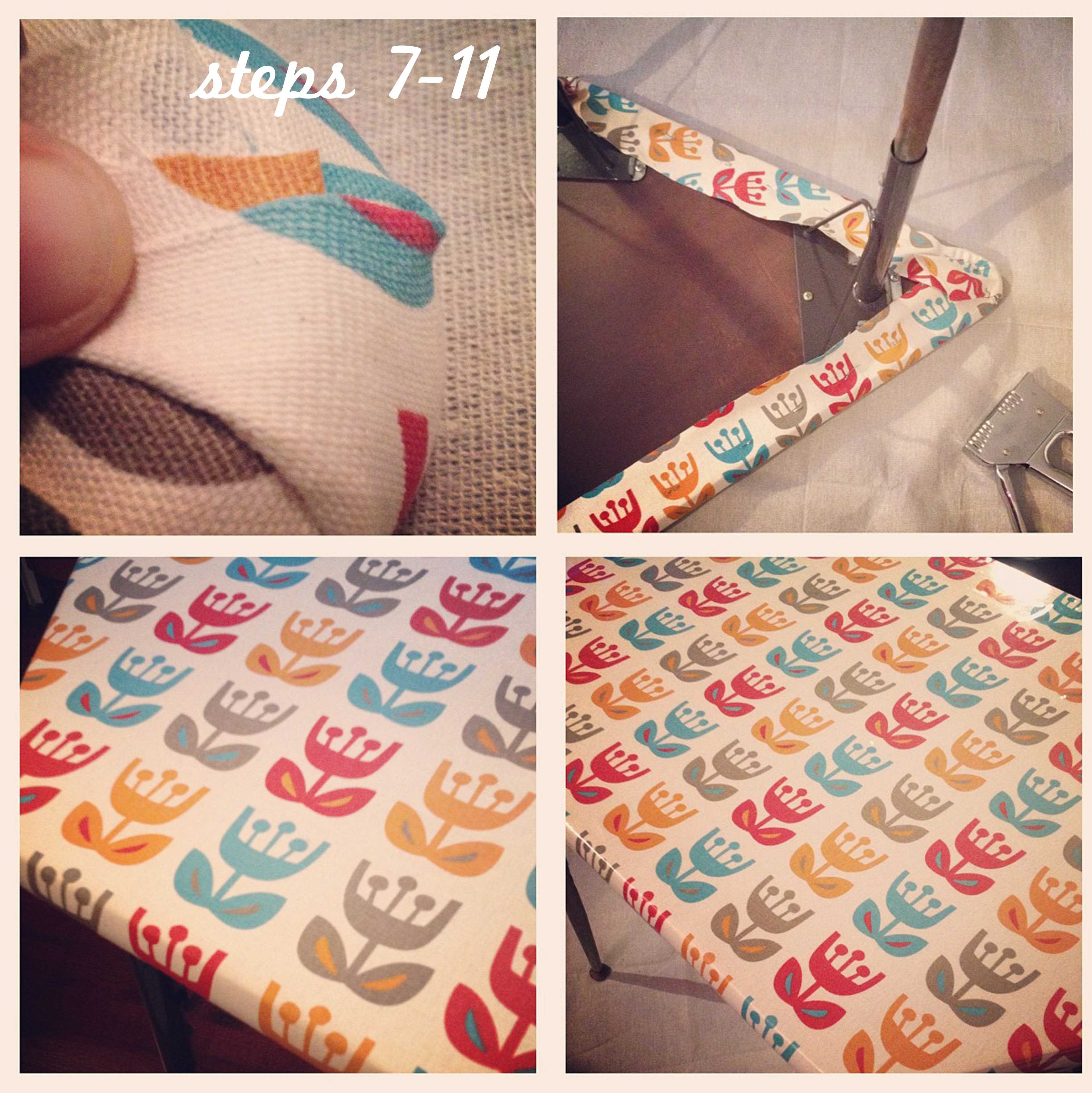
7. Corner up: Pull the fabric up at a 90 degree angle and pull firmly inward. 

If the corner is rounded (like mine), it will naturally make a little pleat of sorts when you pull up & in, it’s okay, just roll with it but feel free to adjust how it looks before you staple it down. Staple it a few times to anchor it securely to the table.

If your corner is sharp, pull one edge in towards the center of the table & staple it down. Tuck & fold the fabric however you need to get a nice crisp corner before stapling the heck out of it.

8. Trim: Using your fabric shears/scissors, trim the edge of the fabric to even it out a bit & get rid of any floppy edges. I started using a straight edge & rotary cutter on one side & soon realized it was silly so I eyeballed the rest. It will be hidden, after all!

9. Flip: Turn your table right side up & use a lint roller to catch any stray fabric bits or dust (or pet hair) from the fabric. It will drive you nuts if you accidently trap a hair or thread forever in the next step!

10. Repeat steps 2-8 using the vinyl. You can be a little firmer with the vinyl because you want to pull it taut. Especially in step 7 – you’ll want to pull a little tighter on the vinyl so it stretches nicely over the corners.

11. Turn the table right side up & admire your work!

Maker’s notes:  
I was oh-so-excited to get this project started, I forgot to take a “before” picture! Oops! 
I ran out of the right staples as I was about 3/4 of the way into the project so I finished it with staples that weren’t quite meant for the job (they had little arcs at the top for fastening cords to a surface). I smashed the extra metal flat with a hammer. I’d recommend running to your nearest home store for a refill instead of making due as I did.

Weekday Breakfast Treat | Almond Butter Delight

28 Mar

A couple of years ago I was fortunate enough to spend a few days at Canyon Ranch on a work trip to Arizona.

The food was delicious and healthy. It was refreshing not to have to worry about scavenging protein for breakfast or deconstructing pre-made hotel sandwiches to create a healthier lunch option.

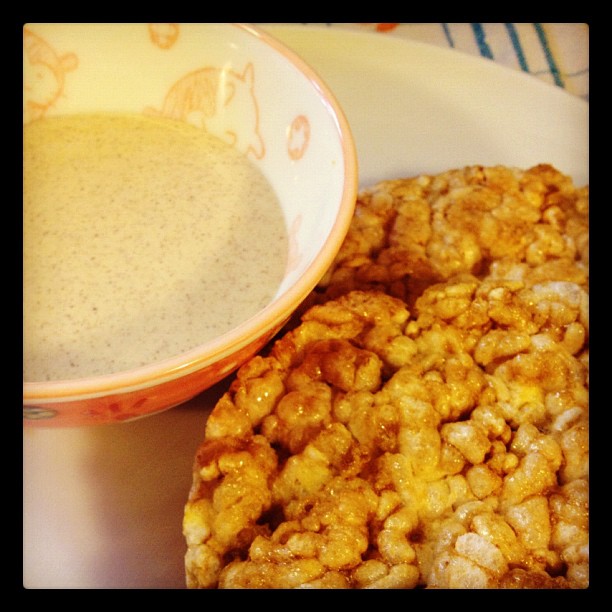
This recipe was one of my favorite things from the breakfast spread at Canyon Ranch. I like to put it on thin wheat crackers (like Ak Mak or Wasa Thin & Crispy Flatbread). Jess prefers to spread it on caramel rice cakes. It would also be yummy as a dip for fresh fruit.

My favorite thing about it (aside from it’s deliciousness) is that it’s really easy to whip up a batch for the week.

(Recipe from Canyon Ranch)

Makes 10 (2-TBS) servings

Ingredients

1 cup nonfat ricotta cheese 

2 tsp vanilla extract

½ tsp ground cinnamon

1 ½ TBS honey

¼ cup almond butter (without added salt)

Steps

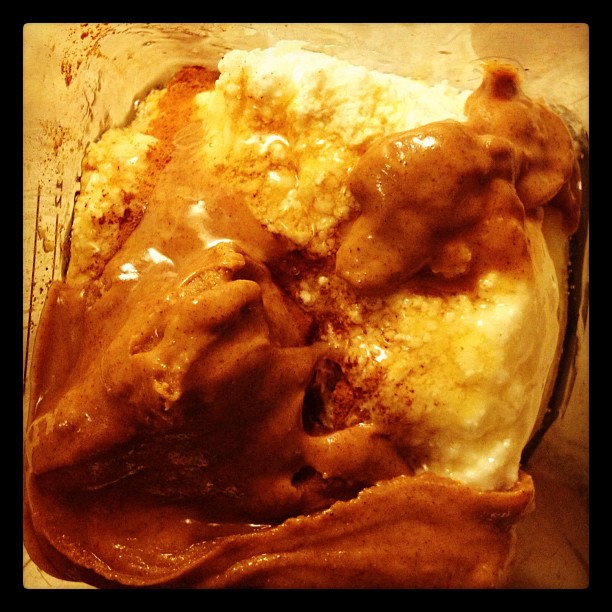
1. Combine all ingredients in a blender container & puree until smooth. (It might seem a little loose but it will firm up a bit after it’s been chilled in the refrigerator for a few hours.)

2. Chill in the refrigerator until ready to use. Enjoy within one week.

Nutritional info: 65 calories, 4 grams fat, 5 grams protein, 5 grams carbohydrate, 2 milligrams cholesterol, 12 milligrams sodium, trace fiber 

 Notes: I buy the highest quality ricotta that I can find & swear it makes all of the difference in this recipe. My favorite is Calabro Fat Free Ricotta. It’s so good I eat it straight out of the container sprinkled with a little bit of salt & pepper. YUM!

 Tip for accurately measuring honey in recipes: Spray the measuring cup or measuring spoon with a little bit of non-stick cooking spray before measuring the honey. The honey will easily slide into the recipe – no sticky messes or sad dollops left behind on the measuring implement. 

Take it Slow Sunday | “Japanese” Iced Coffee

25 Mar


I’ve never liked waiting but as an adult, I’ve grown to appreciate that really amazing things in life take time.

It’s true. Jess and I met a little bit later in life and I’m finally at a stage in my life where I have many “I can’t believe I get paid to do this” moments. Though when it comes to most things (like standing in the grocery line or walking behind a very slow walker), patience is on my list of improvement areas…but when it comes to coffee, I’m happy to wait.

It’s still March, but the weirdly warm weather has spurred blooming trees, chirping birds, porch parties and my daily craving for iced coffee.

Jess discovered this brewing technique shared by Erin Meister, a Counter Culture Coffee barista trainer, a few years ago and it’s still our favorite way to make iced coffee. It’s also very economical. (Double yay!)

Note: We make it exactly as above but use a 10-cup Chemex & a folded Chemex filter that we dampen under the faucet (to diminish any flavors that the dry paper filter might impart to the delicious coffee) before adding the ground coffee & pouring the water over.  

Thrifty Craft | Calendar Envelopes

21 Mar


It’s my natural instinct as an artist to hoard *um, I mean be SUPER resourceful about* materials that inspire me to make them over & use them again. Here’s a fun project that I came up with last year as a way to use our 2010 calendar (I couldn’t bear to recycle all of those cute Boston Terrier PUPPIES!). We are always in need of envelopes for our dog walker’s bi-weekly payment, etc. & we like to keep corresponding fun. These also make a cute gift paired with some pretty colored blank cards & tied up with some baker’s twine.

Materials

1 old calendar (the more interesting, the better!)
1 envelope (small-medium) 
pair of scissors
ball point pen or pencil (for tracing template) 
straight edge (I prefer a cork backed metal ruler)
bone folder or popsicle stick
magazine or self healing cutting mat (to protect your work surface)
glue stick

Steps

1.Disassemble the calendar & cut the calendar pages in half. Set the cover of the calendar aside.

2. Carefully slide your finger under the glued edges of the envelope & pull it apart, smoothing it flat. (If you’re worried about ripping it, steam it open over a kettle or pot of boiling water. The envelope I used — a stray that I found in the bottom of our filing cabinet — came apart just fine without any extra effort.)

3. Take the cover of the calendar (or any other sturdy piece of cardboard or card stock you have lying around), trace the envelope onto it using the ball point pen/pencil & cut it out. This is your “template”!

4. Trace your template onto the calendar pages. I traced the side of the calendar page with the image on it because I wanted to be very intentional about how the image would appear on the finished envelope but you could trace the template on the other side if you’re worried about the pen marks showing up on the finished envelope. Speaking of…I used a Sharpie so it would show up in pictures for this tutorial but I’d recommend using something with a finer tip.

5. Cut out your calendar page envelopes.

6. Using your bone folder (or tip of a popsicle stick) & straight edge, create a crease along each side of the envelope. (Just match up the corners with your straight edge & slide the bone folder along the edge — using the point to create a little invisible line in the paper.)

7. Fold each flap of each envelope on the creases.

8. Place a folded envelope on top of a piece of scrap paper  & glue the sides of the bottom flap. Fold it in and smooth it down (make sure the bottom corners are really glued down!). Repeat for the remaining envelopes.


Maker’s note: As I use each envelope, I seal the top flap with a little piece of tape, a swipe of a glue stick or a decorative label/sticker.
If your calendar images are really bold/dark, you might also want to stick a label on the front of the envelope for the address.

Sunday Scones | Fresh Cranberry Orange Cream Scones

18 Mar

Last weekend, we needed to come up with a sweet baked brunch treat to bring to our friends’ house for a long awaited get together. Little did we know, whatever we brought had to compliment yummy savory quiches (2 types!), a fresh fruit salad & perfectly slow brewed coffee (Stumptown in a Chemex…more on that in a future post). We made scones & it was, after all, a delicious & adorable visit (complete with a baby AND a pup!).

I don’t make scones often but know that they’re best when baked & enjoyed the same day. That said, I couldn’t imagine getting up at 5:00 AM on a Sunday to bake two batches of scones. Yes, that’s right, TWO batches. (We couldn’t decide on which recipe to bake so I took a quick poll at work one afternoon. The response was split down the middle. That was it, my mind was made up — I’d definitely make both.)

I searched the interwebs & our library of baking/cook books for information about making the dough in advance and found tips for freezing unbaked scones but very little information about refrigeration. Now that I’m thinking of it – I should have consulted our dear friend, Cobrina – pastry chef extraordinaire. Silly me! Note to self for next time…

Ok, so here are a couple of helpful tips I found in my scone research:

  • As with most pastry recipes, very very cold butter yields the best results
  • Brown sugar is a nice substitute for granulated
  • The brand of all purpose flour matters (really! some are higher in protein than others which can affect the end consistency of the scones)

What did we do?

Well, since we’ve had good luck refrigerating similar types of dough, we figured that refrigerating the cut & prepared scones overnight couldn’t hurt.  So…we made the dough for the two recipes, cut the scones & put them on cookie sheets, covered them & popped them in the refrigerator (precariously balanced on containers of milk and pickles and stacked Chobani yogurt). We tossed them in a preheated oven the next morning. They took a little bit longer to bake (just a few minutes) but it worked out perfectly in the end.

Today, I’ll share our favorite of the two recipes with you.

(Adapted from Joy the Baker’s Fresh Cranberry Cream Scones with Candied Ginger)

Recipe makes 6 scones

Ingredients

2 cups all-purpose flour

¼ cup light brown sugar

2 tsp baking powder

¼ tsp salt

½ cup (1 stick) unsalted butter, cold & cut into cubes (I froze it for a couple of hours first)

1 large egg

1 tsp pure vanilla extract

½ cup heavy cream, cold

1 heaping cup coarsely chopped fresh cranberries (I had some in the freezer from our late fall trip to Cape Cod to visit my dad – I defrosted them & then cut them each in half)

1 tsp orange zest

1-2 TBS cream (for brushing scones)

For the glaze

1/3 cup freshly squeezed orange juice (approximately 1 medium orange)

1 ¼ cups confectioners’ sugar

1 TBS honey

Steps

1. Place a rack in the center of the oven and preheat oven to 375 degrees F. Line a baking sheet with parchment paper & set aside.

2. In a food processor, add flour, sugar, baking powder & salt. Give a quick pulse to mix the dry ingredients. Add the cold butter & process until the butter is well incorporated in the flour mixture. Some butter bits will be the size of peas & some will be as small as oat flakes. Don’t panic, this is exactly how it should be. 

3. In a small bowl, whisk together the egg, vanilla extract and heavy cream. Add the cream mixture all at once to the flour mixture in the food processor and process until everything comes together & forms a ball. Do not over mix! It will be very obvious when it happens — the ingredients suddenly combine to form a ball – it’s a little magical & less messy (no kneading required…yay!).
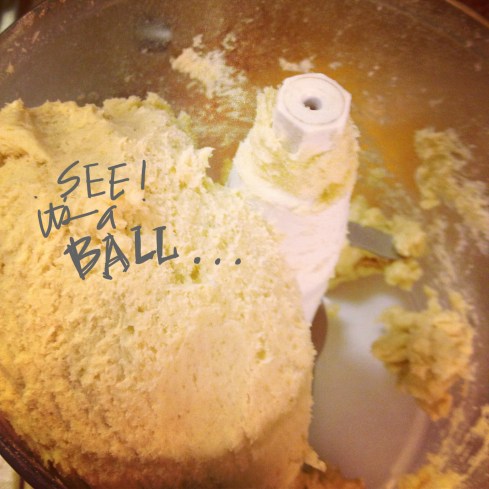
4. On a floured work surface, divide the dough in half and press each into a roundish disk.

5. In a small bowl, toss the cranberries with orange zest. 

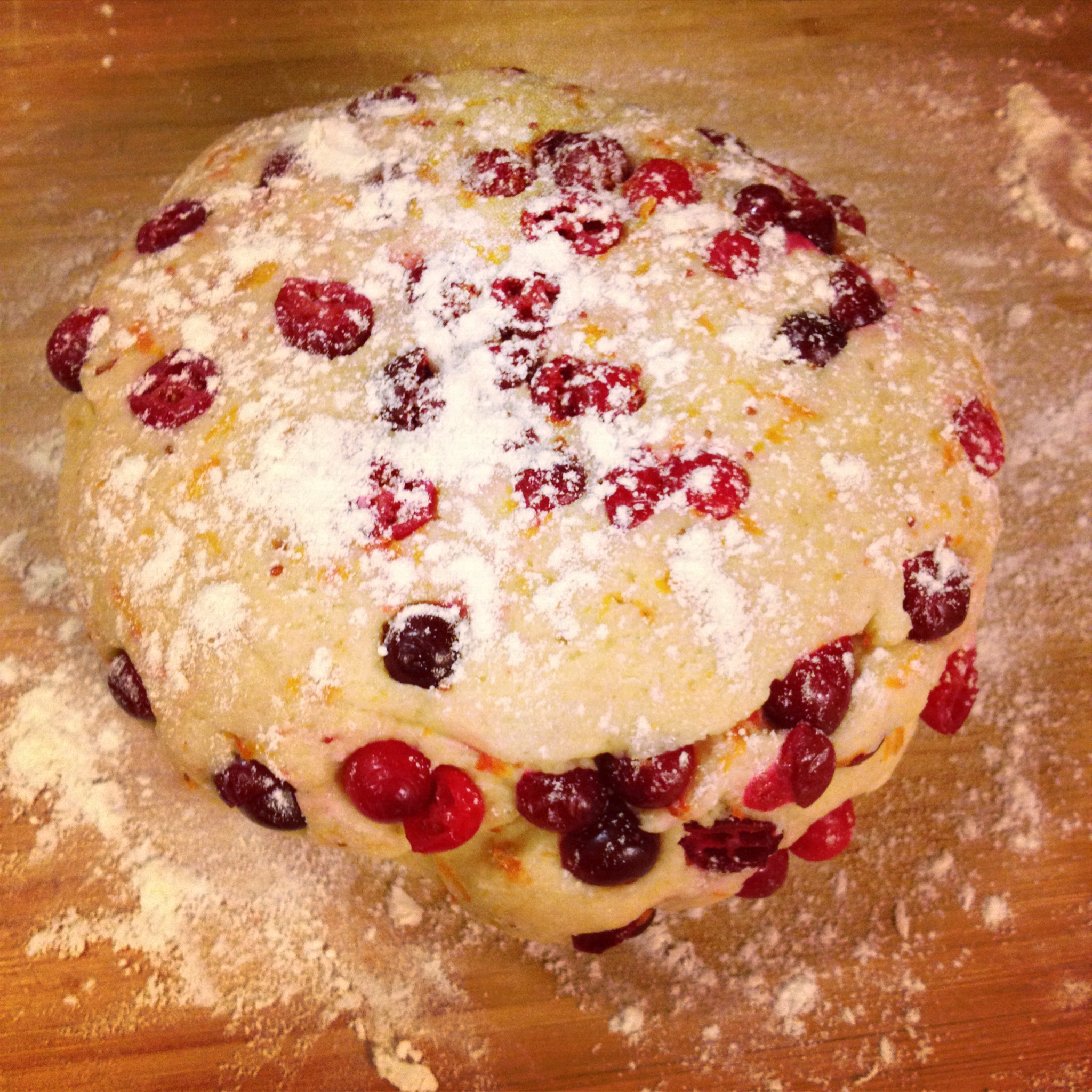
6. Press the zesty cranberries onto one half of the dough & then place the other half of dough on top. Congrats! You’ve made a zesty cranberry filled dough sandwich…mmm!  Fold the stacked cranberry dough in half a couple of times to combine the cranberries. It will seem like there are a lot of cranberries poking out. It’s okay. You don’t want to over knead the dough.

7. Pat the dough into a 1 ½ inch thick disk.
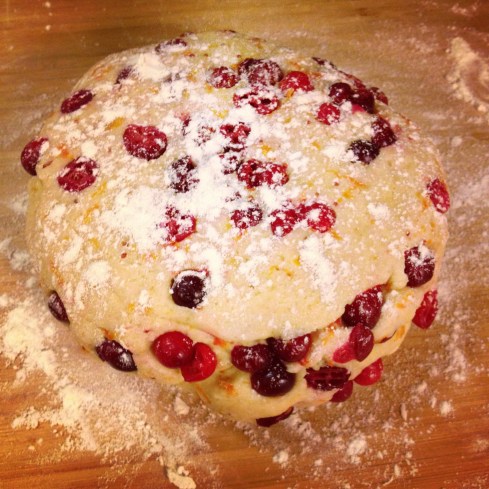
8. Cut the disk into 6 wedges.

9. Place the wedges 2 inches apart on a baking sheet and brush tops with a little cream. (If you aren’t going to bake them until the next day, skip the cream for now, cover with plastic wrap & toss them in the refrigerator. Brush the tops with cream right before putting them in the oven & note that they might have to bake a few minutes longer because they’ll be really cold.)

10. Bake for 15 minutes until just cooked through. Remove from the oven and allow them to cool on a cooling rack.

11. As the scones are cooling, in a small bowl, combine the O.J., confectioner’s sugar and honey with a fork or whisk.

12. Once the scones are cool, place a baking sheet under the cooling rack (for easy clean up!). Use a tablespoon to drizzle a little glaze on top of each scone. Let the glaze set before placing the scones on a plate or wrapping them up (this will take about 10-15 minutes).

 Serve at room temperature or warm them slightly in the oven before serving. Scones are best when served the day they are made, but these will last well wrapped at room temperature for up to 3 days.

 The result: A tasty scone with really great texture (not too dry & not fluffy or biscuit-like). The tart cranberries & bright orange zest perfectly balance the sweetness of the sugary glaze. We only wish the recipe made more! 

St. Patrick’s Day Baking Challenge | Vegan Dutch Oven Irish Soda Bread

17 Mar

If you aren’t vegan, you might have the same reaction to vegan Irish soda bread that Jess’s gram had when she told her we were making our St. Patrick’s day “boiled” dinner in the crockpot.

“What?! That’s not how you do it! You boil it all together in a pot on the stove & change the water 1/2 way through. THAT’S how you make a boiled dinner.”

(Adapted from Smitten Kitchen’s Skillet Irish Soda Bread)

Makes one (delicious) loaf

Ingredients

¼ cup Earth Balance Buttery Sticks, melted

3 cups King Arthur Unbleached All Purpose Flour

2/3 cup vegan sugar

1 TBS baking powder

1 ½ tsp salt

1 tsp baking soda

1 ¾ cups soy milk

1 ½ TBS apple cider vinegar

6 TBS Nayonaise (vegan mayo)

1 ½ cups raisins

Steps

1. Preheat oven to 350 degrees. Grease a dutch oven or ovenproof skillet with nonstick spray, line with parchment paper, and spray lined dutch oven again. (I used a Le Creuset 3.5 quart oval dutch oven)

2. Combine soy milk and apple cider vinegar and let sit for 15 minutes. This will curdle and turn into vegan “buttermilk”.

3. In a large bowl, whisk together flour, sugar, baking powder, baking soda and salt. In a small bowl, combine “buttermilk”, Nayonaise, and 2 TBS of melted Earth Balance.

4. Add wet ingredients to the dry ingredients and stir until just combined. Don’t over mix. Stir in raisins.

5. Pour batter into the dutch oven. Brush the top with the remaining Earth Balance.

6. Bake until golden and firm to the touch, about 1 hour. Cool in dutch oven on wire rack for about 10 minutes. Remove bread from dutch oven & set on wire rack to finish cooling.

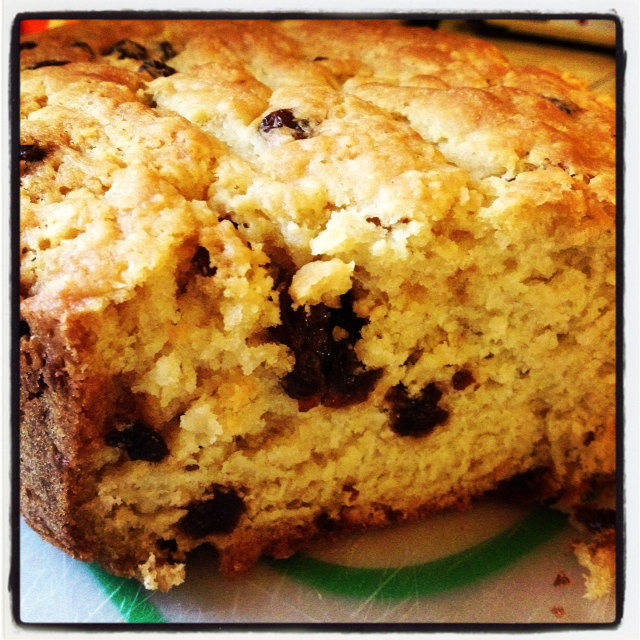
The result: A yummy bread that seems a little more moist than other Irish soda breads I’ve tried (this is a good thing!). It tastes so much like the traditional recipe, even your gram will be none the wiser.